
Overview
Most patients who have a dental crown placed are told it will last a long time without much clarity on what that means in practice. Ten years? Twenty years? Longer? The honest answer is that it depends on several factors that are partly within the patient’s control and partly determined by how well the crown was made and fitted. Understanding what drives crown longevity is useful because it tells you what to do to protect your investment and what to watch for as the years go on. At Oraluxe Dental and Aesthetic Clinic in Janakpuri, Dr Ashwani Kumar fabricates and fits crowns with a focus on long-term performance rather than just immediate aesthetics. This is what actually determines how long a crown lasts.
What a Dental Crown Is and What It Is Protecting
A dental crown is a full-coverage restoration that fits over the entire visible portion of the tooth above the gum line. It restores shape, size, and function to a tooth that has been damaged enough that a filling alone cannot provide adequate protection. The crown distributes biting forces more evenly than a heavily filled tooth, protects against fracture, and, in the case of a root canal-treated tooth, seals the internal structure that is now more brittle than a living tooth. The crown does all of this continuously, under the forces of biting and chewing, across thousands of meals over years. The material it is made from, how accurately it was fitted to the tooth margin, and how well the underlying tooth and supporting gum are maintained determine how long it can keep doing its job effectively. A dental crown placed after root canal treatment is particularly important because the treated tooth has no blood supply and is structurally more vulnerable than a vital tooth.
How Long a Crown Should Realistically Last
With proper care and good oral hygiene, a well-made dental crown typically lasts between 10 and 20 years. Porcelain-fused-to-metal crowns are at the lower end of this range in terms of longevity; in some cases, full ceramic or zirconia crowns are at the higher end due to better material properties and reduced risk of chipping that affects porcelain layering. Some crowns last well beyond 20 years. Others need attention before the 10 years are up. The spread is not random. It reflects the specific factors described below.
What Affects How Long a Crown Lasts
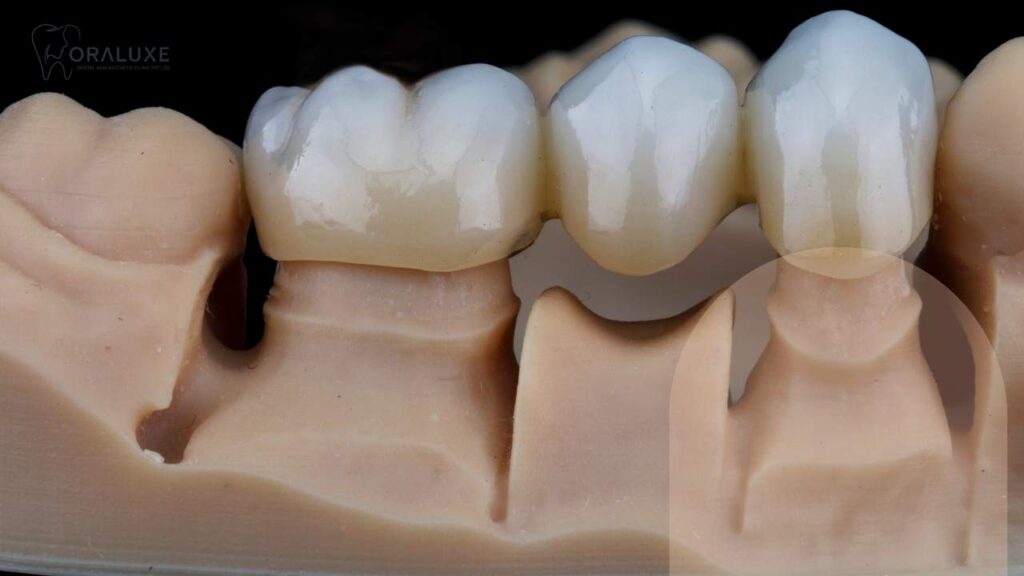
The fit at the crown margin is one of the most critical factors. The margin is where the crown meets the tooth at the gum line. If this interface is not perfectly sealed, bacteria penetrate the gap over time, decay develops underneath the crown, and the crown fails even though the crown material itself is intact. Accurate impression or digital scanning technique and precise laboratory fabrication are what produce a well-sealed margin. At Oraluxe, crown fabrication uses current impression and scanning technology to ensure marginal accuracy from the start. Oral hygiene at the crown margin determines how well that seal holds over time. The area where the crown meets the tooth is the most vulnerable spot for decay development. Brushing the gum line thoroughly and flossing or using interdental brushes to clean between the crown and adjacent teeth is what prevents the bacterial accumulation that leads to marginal decay. Patients who maintain meticulous oral hygiene consistently have crowns that outlast those of patients with patchy hygiene by significant margins. Bruxism, which is tooth grinding during sleep, places repeated excessive forces on crowns that they were not designed to withstand continuously. Grinding can fracture porcelain crowns, loosen cement bonds, and wear the opposing natural teeth. A night guard worn consistently is essential for patients who grind. Without it, even a well-made crown in a grinder will fail earlier than expected. The material chosen for the crown affects both its aesthetic life and its mechanical life. Zirconia crowns have excellent fracture resistance and maintain their appearance well over time. Full porcelain crowns have outstanding aesthetics but can chip under heavy biting forces. The choice of material for each crown at Oraluxe is made based on the tooth’s position, the biting forces it receives, and what the patient’s clinical situation requires, rather than a default preference.
Signs That a Crown Needs Attention
Patients addressing a crown at the same time as other cosmetic concerns often review veneers for adjacent teeth to achieve a more uniform smile.
Sensitivity to temperature that develops in a tooth that previously had no sensitivity suggests decay has developed at the margin or the crown cement has failed. Pain with biting indicates either that the crown height is not correctly balanced with the opposing teeth or that something has changed inside the tooth. A crown that rocks or feels loose when touched with the tongue has failed in its cement bond and needs to be recemented or replaced before the tooth underneath is damaged by unprotected exposure. Visible chips or cracks in the crown material need assessment to determine whether they can be polished or whether replacement is the appropriate response. Regular check-up appointments at Oraluxe allow Dr Ashwani to identify these issues at an early stage rather than when they have progressed. Crowns that are flagged at a routine appointment for early marginal gaps or minor issues are manageable problems. The same crown left until the patient notices pain or obvious visible changes is a more complex and more expensive problem. For patients who are also considering cosmetic improvements alongside restorative treatment, the crown consultation is a natural opportunity to discuss smile design, veneers, or Invisalign aligners as part of a broader plan that addresses both function and appearance together.
Conclusion
A dental crown should last a decade or more with good oral hygiene, appropriate material selection, and regular monitoring. The patients who get the most from their crowns are those who maintain the gum line meticulously, wear a night guard if they grind, and attend check-up appointments consistently so early issues are caught before they require full replacement.
Frequently Asked Questions
Q. Can a crown be replaced if it fails at Oraluxe in Janakpuri?
Yes. Crown replacement is a straightforward procedure when the underlying tooth structure is intact. If decay has developed under the failed crown, that is treated before the new crown is fitted. Dr Ashwani assesses what is needed at the examination appointment.
Q. How do I know if my crown needs replacing versus just recementation?
A crown that has come off with the inner surface intact and the tooth underneath undamaged can often be recemented. A crown with decay underneath, a broken margin, or significant wear needs replacement. Dr Ashwani examines both the crown and the tooth to determine the appropriate course.
Q. What is the difference between porcelain and zirconia crowns at Oraluxe?
Zirconia is stronger and more fracture-resistant than porcelain. For back teeth that receive heavy biting forces, zirconia is often the better choice. Porcelain produces the most natural aesthetic appearance and suits front teeth where biting forces are lower. Dr Ashwani recommends the material based on the specific tooth and clinical requirements.
Q. Can a crowned tooth be part of a smile makeover at Oraluxe?
Yes. Crowned teeth can be included in a smile design plan. The crown shade is matched to adjacent teeth or to the overall planned smile shade. Cosmetic work, including veneers and whitening, is coordinated with crown treatment for a cohesive result.
CTA