
Overview
Dental implants have a reputation for being expensive. That reputation is not unfounded. They cost significantly more than a bridge or a denture, and the gap is large enough that most people pause before committing. The question that follows is a fair one. Is the price reflecting something genuinely better, or is it largely about the technology sounding impressive?
The honest answer is that dental implants are not expensive because of branding. They are expensive because they do something no other tooth replacement option does. They replace the root, not just the crown. And that difference has consequences for your jaw, your neighbouring teeth, and the long-term cost of managing your oral health, which most people are not shown clearly enough before they make a decision.
At Oraluxe Dental and Aesthetic Clinic in Janakpuri, dental implants are placed by Dr Ashwani Kumar, an Oral and Maxillofacial Surgeon with specific expertise in implantology. The approach is built around long-term outcomes rather than short-term cost comparisons.
What Does a Dental Implant Actually Replace?
This is where the value comparison has to start. A dental implant replaces two things. The root and the crown.
Every other tooth replacement option, bridges and dentures, only replace the visible crown. The root is gone, and nothing goes back into the jaw where it used to sit.
That matters because the jawbone is maintained by the stimulation it receives from tooth roots. When a root is missing, the bone in that area begins to resorb. Gradually. Quietly. Over months and years, the jaw in that area shrinks. With a bridge, this happens slowly under the suspended artificial tooth. With a denture, it happens more rapidly across the whole area of missing teeth as the gum and bone beneath the denture gradually reduce in volume.
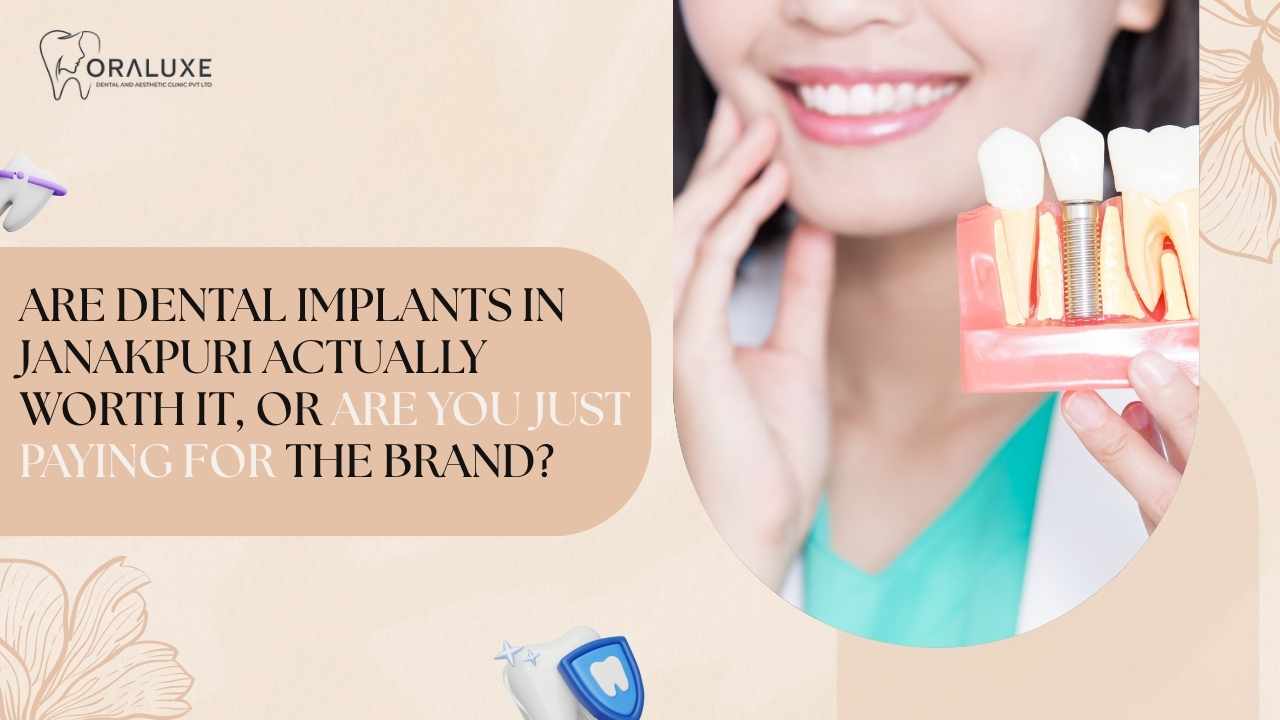
A dental implant is a titanium post placed directly into the jawbone. Once it integrates with the bone, it functions like a natural root, transmitting the forces of biting and chewing into the jaw and maintaining the bone density that would otherwise be lost.
How Does the Long-Term Cost Actually Compare?
This is the calculation most people do not do before deciding that implants are too expensive.
A dental bridge requires grinding down the healthy teeth on either side of the gap to support the replacement. Those teeth are permanently altered. The bridge typically lasts 10 to 15 years before needing replacement. When it does, the supporting teeth that were ground down are further compromised, and the replacement process begins again with more damaged foundations.
A denture requires regular adjustments as the jaw shape changes with bone resorption. It eventually needs replacing as the fit deteriorates. The ongoing cost of adjustments and replacements over 10 to 15 years adds up significantly.
A properly placed implant with good oral hygiene lasts decades and in many cases a lifetime. The crown on top may need attention after 15 to 20 years, but the implant itself, once integrated, does not need replacing. Over a 20-year period, the total cost of a dental implant is frequently lower than the cumulative cost of managing a bridge or denture through the same timeframe.
What Does the Implant Process Look Like at Oraluxe?
The process is more straightforward than most people expect once they understand the stages.
Consultation and Imaging
The initial consultation at Oraluxe includes a clinical examination and imaging to assess bone volume and density at the implant site. Where bone has been lost over time, grafting may be needed first to rebuild the foundation. This is discussed honestly at the consultation based on what the imaging actually shows.
Implant Placement and Healing
Implant placement is a minor surgical procedure performed under local anaesthesia. The titanium post is placed into the prepared bone site. A healing period follows, during which the implant integrates with the bone. This process takes several weeks and is what makes the implant stable enough to bear the forces of chewing long-term.
Final Crown Placement
Once integration is confirmed, the crown is designed and fitted. At Oraluxe, the crown is fabricated to match the colour, shape, and size of the surrounding teeth so the result looks completely natural.
Realistic Treatment Timeline
The full process from consultation to final crown takes several months in most cases. Patients who are told it can be done in a week at certain clinics should ask carefully about what is actually being shortened and what that means for long-term stability.
Who Is a Good Candidate for Dental Implants in Janakpuri?
Most adults in good general health with adequate bone volume at the implant site are suitable candidates. The main variables are bone density, gum health, and any medical conditions that affect healing.
Uncontrolled diabetes, active gum disease, and certain medications need to be addressed or considered before implant placement, but do not necessarily rule out treatment. Dr Ashwani Kumar assesses each case individually rather than applying blanket exclusions.
People who have been told elsewhere they do not have enough bone for an implant are often worth a second assessment. Advances in bone grafting mean significantly more cases are treatable now than they were a few years ago. You can read more about full arch rehabilitation at Oraluxe for patients considering multiple implants or complete mouth restoration.
What About Full Mouth Implants?
For patients who have lost most or all of their teeth, individual implants for every missing tooth are not the only option. Full arch restoration using a smaller number of strategically placed implants to support a complete set of fixed teeth is available at Oraluxe.
This approach gives patients fixed teeth that function normally without the daily management of dentures. No adhesive, no removal, no limitations on what you can eat. For patients who have been managing with dentures for years, the difference in the quality of daily life is significant.
Full arch rehabilitation at Oraluxe is planned and executed by Dr Ashwani Kumar, whose surgical background in oral and maxillofacial surgery gives him the specific training this type of case requires.
How Do Implants Fit Into Overall Dental Health at Oraluxe?
Oraluxe treats implants as part of a comprehensive approach to oral health rather than an isolated procedure. Patients who come in for implants are also assessed for gum health, bite alignment, and the condition of remaining teeth.
If other dental concerns exist alongside the need for implants, these are addressed in a coordinated sequence. A smile design consultation may be relevant for patients who want to address the appearance of the overall smile, alongside restoring missing teeth. Dental crowns on adjacent teeth are sometimes part of the same treatment plan if those teeth also need restoration.
Conclusion
Dental implants in Janakpuri are not expensive because of branding. They cost what they cost because they replace the root, preserve the jawbone, leave neighbouring teeth untouched, and last significantly longer than the alternatives. Whether the investment makes sense for a specific individual depends on their age, oral health, and long-term goals, which is exactly what a consultation at Oraluxe is designed to assess honestly.
Frequently Asked Questions
Q. How long do dental implants last in Janakpuri? With proper care, a dental implant can last a lifetime. The crown on top may need attention after 15 to 20 years. The implant itself, once integrated, is designed to be permanent.
Q. Is dental implant surgery painful? The procedure is done under local anaesthetic. Most patients describe mild soreness and swelling for a few days afterwards, manageable with standard pain relief. Dr Ashwani Kumar’s surgical background in oral and maxillofacial surgery means the procedure is performed with precision that minimises tissue disruption.
Q. How long does the full implant process take at Oraluxe in Janakpuri? From initial consultation to final crown placement, the process typically takes 3 to 6 months, depending on whether bone grafting is needed and how the healing progresses. A realistic timeline is discussed clearly at the first consultation.
Q. Can I get dental implants if I have had missing teeth for years? Yes, in most cases. Long-standing missing teeth often involve some bone loss, which may require grafting before placement. This is assessed at the consultation and planned accordingly rather than used as a reason to decline treatment.
Q. What makes dental implants different from bridges? Dental implants replace the missing tooth root, while bridges only replace the visible crown and require support from neighbouring teeth.